

Frenchie harness fit: why a collar chokes and a harness doesn't
A dog collar puts the leash pull on a narrow band around the neck. On a Frenchie, that band sits right over a short, thick neck with a flat face directly above it — pull on the leash, and the pressure has nowhere to go but straight into the front of the throat. Owners notice this fastest at the exact moment a Frenchie spots a squirrel and lunges: a sudden gag or cough that stops as soon as the leash goes slack again.
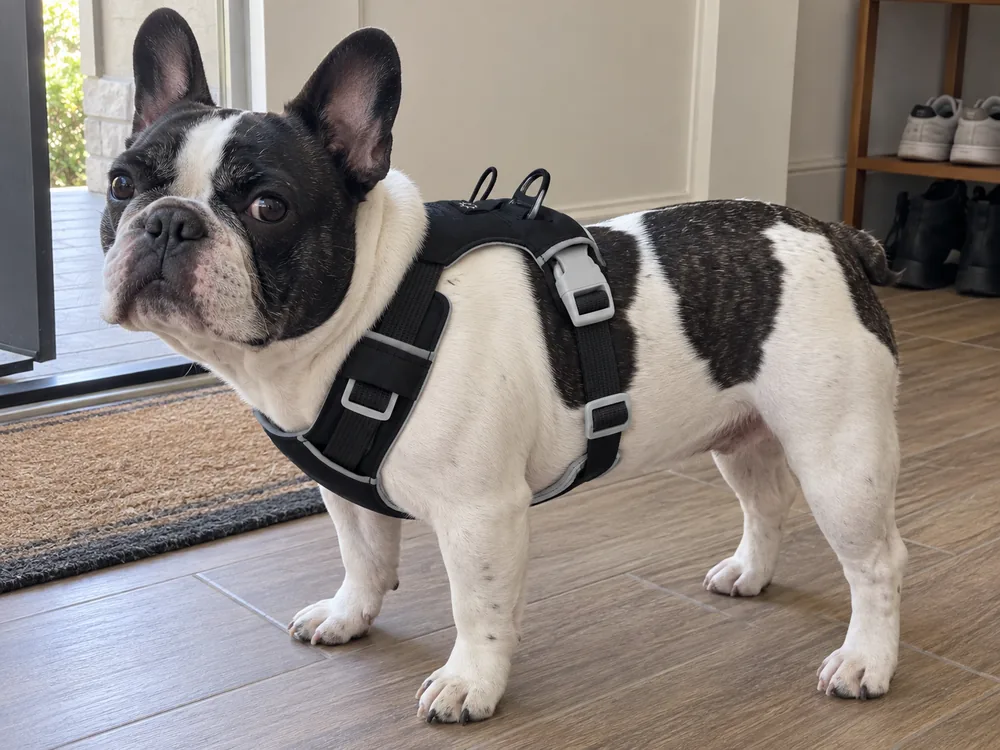
A frenchie harness moves that same pull onto the chest and shoulders instead. Spread across a wider panel of fabric, the same amount of leash tension lands on far more surface area, and none of it touches the windpipe. That's the entire mechanical reason a harness works better than a collar for a short-necked breed — not a brand claim, just where the force goes.
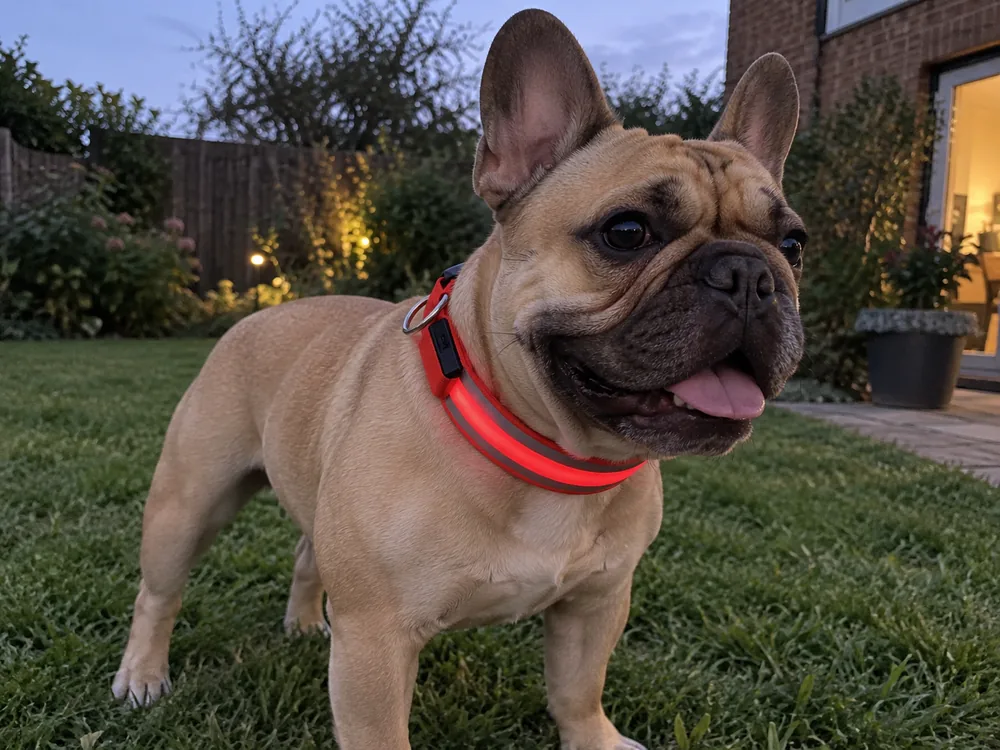
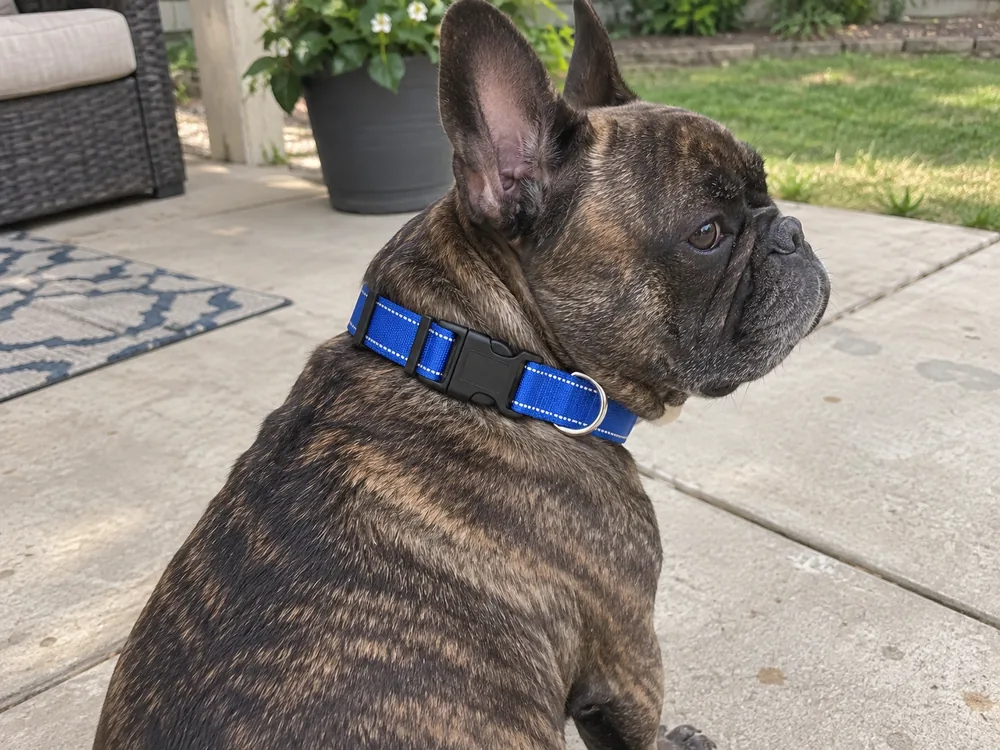
This doesn't mean the collar disappears from the house. A flat collar with ID tags still belongs on your Frenchie at home and in the yard — it's the leash clip that moves to the harness once you're heading out the door.

Frenchie harness sizing: how to measure your dog's neck and chest
Every dog harness for Frenchie owners comes down to two numbers: the neck, measured where a collar would sit, at the base of the neck; and the chest, measured around the widest part of the ribcage, right behind the front legs. Use a soft tape measure, not a stiff one, and pull it snug against the fur without pinching the skin underneath.
Where the tape actually goes
Stand your Frenchie square on all four feet, and measure at rest rather than mid-fidget. Wrap the tape around the base of the neck first — the spot a collar naturally sits — and read the number without pulling it tight. Move the tape back to just behind the front legs for the chest measurement, at the widest point of the ribcage, and read it the same way: snug, not compressed. A second person holding a treat at nose height keeps most Frenchies still long enough to get both numbers right the first time. Any soft measuring tape works, including a fabric one from a sewing kit — the material matters more than the brand on it, since a stiff carpenter's tape won't curve evenly around a barrel-shaped chest.
Weight alone doesn't work for this breed. Two Frenchies at the same weight can carry very different chest measurements because of how wide and deep the ribcage sits, so a size chart built around a weight guess will be wrong on a barrel-chested dog more often than it's right. Neck and chest, taken with a tape, are the two numbers that actually decide fit.

Here's the size chart for our own step-in set, built from these two measurements rather than a weight guess:
| Size | Neck | Neck (in) | Chest | Chest (in) |
|---|---|---|---|---|
| XS | 28–34 cm | 11–13.4 in | 32–36 cm | 12.6–14.2 in |
| S | 32–38 cm | 12.6–15 in | 36–42 cm | 14.2–16.5 in |
| M | 36–42 cm | 14.2–16.5 in | 40–46 cm | 15.7–18.1 in |
| L | 40–46 cm | 15.7–18.1 in | 44–52 cm | 17.3–20.5 in |
| XL | 44–50 cm | 17.3–19.7 in | 50–62 cm | 19.7–24.4 in |
If your Frenchie measures between two rows, take the larger size — the strap adjusters take up the slack a size down can't give back.
Frenchie bulldog harness types: step-in, over-the-head, vest, or Y
Every frenchie bulldog harness on the market is built around one of four basic designs, and they don't fit a short-necked, barrel-chested dog equally well.
Step-in
The harness lies flat on the ground, and the dog steps both front paws into two leg loops before the panel lifts and buckles at the back. Nothing ever passes over the head, which matters for a Frenchie who plants its feet the moment fabric comes near its ears. The trade-off: a step-in only stays secure if the straps are actually snugged down, since there's less structure holding it in place than a design with more panels.
Over-the-head
A loop drops over the head first, like a T-shirt, then a belly strap buckles underneath. It tends to hold a little more snugly than a step-in once it's on, but getting it on is the harder part — many Frenchies duck or back away from anything that comes down over the eyes and ears before they've learned to accept it.
Vest
The most fabric coverage of the four, wrapping the torso front and back. That makes it the warmest option and, fitted correctly, the hardest for a dog to wriggle out of. On a breed that already runs warm from a flat face, the extra coverage is worth weighing against the heat it holds in — more on that further down.
Y-front
Named for the Y-shaped strap pattern across the chest, this style keeps every strap off the throat entirely and gives the most shoulder freedom of the four. It suits dogs with an average chest-to-shoulder ratio better than it suits a Frenchie's unusually wide, short frame, where the Y can sit unevenly without a wide chest panel to anchor it.
A separate question: where the leash clips
How a harness goes on and where the leash clips are two different decisions, and it's easy to mix them up while shopping. A back-clip harness — the leash ring sits between the shoulder blades — is built for comfort on an ordinary walk. A front-clip harness puts the ring on the chest instead, which steers a hard puller sideways when they lunge, doing a training job a back-clip design isn't built for. Any of the four entry styles above can be built with either clip position, so check both before assuming a step-in is automatically a back-clip harness or a vest is automatically a front-clip one.
For the reason most Frenchie owners give when asked — getting a low-slung, barrel-chested dog to hold still while something passes over its head is its own daily fight — the step-in is the design behind our own frenchie bulldog harness.

Frenchie Bear Step-In Harness – Leash Set Made for French Bulldogs
- Step in, lift, click. Nothing ever passes over his head, ears or eyes.
- Padded chest panel takes the pull across his chest instead of at the throat.
- Matching leash included, so you leave with a complete set instead of separate purchases.
Frenchie harness fit check: signs it's loose, tight, or twisted
A harness that fits right shouldn't need adjusting again once you clip the leash on. Getting there takes one check, done every time you put a new frenchie harness on for the first few walks.
The two-finger check
Slide two fingers flat under any strap, against the skin. Two fingers in with a little resistance means the fit is right. One finger, or none, means it's too tight. More than two, or the strap lifts away without resistance, means it's too loose — tighten it before the walk, not after your dog has already backed out on the sidewalk.
Check every strap, not just the one closest to the buckle. An uneven fit on one shoulder is what makes a chest panel twist sideways twenty minutes into a walk, long after the two-finger check at the front door said everything was fine.
Standing still isn't the same as walking
A harness checked while your Frenchie stands square in the hallway can sit differently five minutes into a walk, once muscles are moving and the panel has had a chance to settle against the body. Run the two-finger check again after the first few minutes outside, and once more the first time your Frenchie sits down and stands back up — a fit that held on flat ground can loosen slightly the moment the body changes position.
What to look for after the walk
A flattened patch of fur behind the front legs usually means the chest panel is riding too low. A strap that's left a groove in the fur at the shoulder means that side is too tight. A harness that's rotated so the D-rings sit off to one side, instead of level between the shoulder blades, means the chest panel wasn't centered before the straps went up. None of these are dramatic on a single walk — they're just the signal to recheck the fit before the next one.

Frenchie harness training: getting a reluctant dog used to a new one
A brand-new frenchie harness sitting on the floor is, to a suspicious Frenchie, an unfamiliar object before it's anything else. Let your dog sniff it first, on the ground, with no pressure to put a paw anywhere. A treat dropped near the open leg loops turns the harness into something worth approaching instead of something to avoid.
Put it on for a few seconds at a time before the first real walk — on, treat, off — rather than buckling it up and heading straight out the door. A Frenchie that only ever feels the harness right before something exciting (or something it doesn't want, like a bath) learns to associate the gear itself with the event that follows. A few short, low-stakes practice rounds at home usually settle a dog that freezes or flops over the first time a strap goes on.
Frenchie dog harness materials: mesh lining versus a bare strap
Two frenchie dog harness options can carry the exact same measurements and still feel completely different on the dog, because the material touching the skin is where comfort actually lives.
Mesh lining
A chest panel lined in mesh lets air move against the skin instead of trapping it under a solid pad. On a bare strap — just webbing against fur, no lining at all — the same leash tension lands on a narrower line of contact, which is fine for a light puller but starts to rub on a dog that leans into the leash on every walk.
Strap width and a wide chest
A wider strap spreads the same pull over more skin, the same principle that makes a chest harness better than a collar in the first place, just at a smaller scale. On a Frenchie's especially wide ribcage, a strap under an inch wide concentrates force into a thin band that can slide out of position on a barrel-shaped chest; a padded panel several inches across has more surface to grip and stays put where the body is widest.
Buckles
Most harnesses close with either a plastic side-release buckle — the kind that clicks together with one hand — or a metal D-ring and slide. Plastic side-release buckles are faster to open one-handed; metal hardware tends to hold up longer under repeated daily use. Either is fine as long as it closes with an audible, confirmed click before the leash goes on.
Matching the leash
A leash cut from the same webbing as the harness isn't just a matching look — nylon and mesh wear at roughly the same rate, so a set bought together tends to show its age evenly instead of one piece fraying while the other still looks new.

Frenchie Bear Step-In Harness – Leash Set Made for French Bulldogs
- Step in, lift, click. Nothing ever passes over his head, ears or eyes.
- Padded chest panel takes the pull across his chest instead of at the throat.
- Matching leash included, so you leave with a complete set instead of separate purchases.
Frenchie harness for puppy, adult, and senior — one size doesn't last
The same frenchie harness rules don't apply the same way at every age. A puppy, a full-grown adult, and a senior Frenchie each need something slightly different from the fit.
Puppy
A Frenchie puppy grows unevenly — chest and neck measurements can shift by several centimeters within weeks. Measure again before assuming last month's size still fits, and expect to size up sooner than you would on a slower-growing breed. A harness with several adjustment points buys a few extra weeks out of a size before the next one is needed.
Adult
Once growth levels off, the neck and chest measurements should hold steady for a year or more, which is when the size chart above becomes the reliable reference point rather than a moving target. That doesn't mean the fit never needs a second look — nylon webbing stretches slightly with use, so a strap adjuster that was set once at purchase is worth nudging tighter after the first few months of regular wear, even without any change in your Frenchie's actual size.
Senior
An older Frenchie often moves more stiffly getting up and lying down, which makes a step-in design — no lifting a leg over a loop, no pulling anything over the head — easier on a dog that's slower to settle into position. Weight can shift with age too, in either direction, so a fit that was snug last year is worth rechecking rather than assumed.

Frenchie harness and summer heat: what changes on a hot walk
A flat face moves less air with every breath than a longer muzzle does, which is simply how the anatomy is built — and it's the reason a hot afternoon asks for a different walk than a cool morning does, regardless of what harness is on.
More fabric on the body holds more heat against the skin. A vest harness, with the most coverage of the four styles, is the warmest choice for a Frenchie on a summer walk; a step-in or Y-front with a mesh-lined panel leaves more skin exposed to moving air. None of this is specific to any single anatomy claim — it's the same reason a person wears less on a hot day.
Practical adjustments matter more than the harness choice itself: walk in the cooler hours, keep it shorter, stick to shaded routes where they exist, and carry water for a break partway through. If your Frenchie starts lagging, panting harder than usual, or wants to lie down mid-walk, that's the signal to head home and let things cool off — not to push for one more block.
Color plays a small part too. A dark harness sitting in direct sun picks up more heat than a light one, the same way a black car seat gets hotter than a tan one in a parking lot. It's minor next to shade and timing, but on the hottest days it's one more reason to reach for the lighter color in the drawer.

Frenchie harness care: washing it so it lasts
Hand wash in cool water with a mild soap, and let the harness air dry rather than running it through a washing machine or dryer — both are hard on plastic buckles and any stitched decoration on the panel. Nylon webbing and mesh hold up well to daily walks, but expect the color to fade a shade after repeated washes, and the mesh to show light wear if it's used hard, every day, for years. That's ordinary wear, not a defect.
After a walk through mud, sand, or salt water, rinse the harness before it dries stiff — salt and grit left to sit in the mesh work like sandpaper against the lining every time the harness goes back on. Wash the leash the same way and separately from the harness itself, since a swivel clip left tangled with buckles in a wash basin can nick the finish on both.
Check the hardware every few months: a buckle that doesn't click shut firmly, or a strap fraying at the stitching, is the sign to retire the harness rather than keep patching a walk together with gear that might not hold under a hard pull.
Store it out of direct sun between walks rather than left hanging by a sunny window — sunlight fades webbing color faster than washing does, and a hook by the door out of the light keeps a bright color bright for longer.
Frenchie harness buying mistakes that cost you a second purchase
Most of the frenchie dog harness returns we hear about trace back to one of these mistakes, all of them avoidable before checkout.
- Sizing by weight instead of measuring. A barrel-chested Frenchie can weigh the same as a narrower dog and need a full size up in chest measurement.
- Buying the smallest size out of caution. A tight harness doesn't train better behavior — it just rubs, and a too-small chest panel sits in the wrong place entirely.
- Skipping the two-finger check on day one. A harness that felt fine in the store can sit differently once your Frenchie is moving instead of standing still.
- Choosing a style for looks over function. A vest looks sharp in a photo and runs hot on a summer walk; a bare strap looks minimal and rubs on a dog that pulls.
- Assuming every brand's chart means the same thing. A size labeled Medium on one chart can be a different chest measurement than Medium on another — the actual centimeters are what transfer between brands, not the label.
- Not checking the leash ring position. A back-clip harness bought to correct a hard puller won't do that job, no matter how well it otherwise fits — the ring needs to sit on the chest for that.
- Not checking what's included. Some listings sell the harness alone; others, like our step-in set, include a matching leash, which changes the actual cost of getting out the door.
None of these mistakes are expensive to avoid — they just take five minutes with a tape measure and the size chart before the order goes in.

Frenchie harness compared: step-in set versus collar and thin strap
Numbers, not adjectives, are the fairest way to compare gear — here's where the pull actually lands on three common choices, and what comes in the box with each one.

Numbers, not adjectives, are the fairest way to compare gear — here's where the pull actually lands on three common choices, and what comes in the box with each one.
| Plain collar | Thin strap harness | This step-in set | |
|---|---|---|---|
| Where the pull lands | Neck | Chest, narrow band | Chest and belly, padded panel |
| Adjustment points | 1 | 1–2 | 4 |
| Lining | None | Usually none | Mesh |
| Leash rings | 1 | 1 | 2, side by side |
| Leash included | No | Usually no | Yes, matching |
| How it's worn | Buckle at the neck | Step-in or overhead, one buckle | Step-in, one buckle |
A thin strap harness moves the pull off the neck the same way this one does, and for a light dog on short walks that's often enough on its own — it's the lining, the four adjustment points, and the matching leash that this set adds on top. If your Frenchie already backs out of narrow straps or rubs under a bare one, that's the specific problem the extra padding and adjustment points are built to fix, not a reason to size up or down.
Frenchie Bear Step-In Harness – Leash Set Made for French Bulldogs
- Step in, lift, click. Nothing ever passes over his head, ears or eyes.
- Padded chest panel takes the pull across his chest instead of at the throat.
- Matching leash included, so you leave with a complete set instead of separate purchases.
Gear from this guide
Shop by category: Frenchie Harnesses · Frenchie Dog Collars

Frequently asked questions
What size harness does a French Bulldog need?
It depends on two measurements, not a guess by weight: the neck at the base, where a collar sits, and the chest at its widest point, just behind the front legs. Our own step-in set runs XS through XL, from a 28–34 cm neck and 32–36 cm chest at the small end up to a 44–50 cm neck and 50–62 cm chest at the large end — measure first, then match the row.
How do I measure my Frenchie for a harness?
Wrap a soft tape measure around the base of the neck, where a collar would rest, and read the number without pulling it tight. Then move to the widest part of the ribcage, right behind the front legs, for the chest measurement. Both numbers together decide the size — either one alone can point you to the wrong row on a barrel-chested dog.
Are harnesses better than collars for Frenchies?
For daily walks, yes, and the reason is mechanical rather than a matter of preference: a collar puts the leash pull on a narrow band around a short, thick neck, while a well-fitted frenchie bulldog harness spreads that same pull across the chest and shoulders instead. A flat collar is still fine for holding ID tags at home.
What is the best frenchie harness for a dog that pulls?
A harness with the leash ring on the chest, called a front-clip design, steers a hard puller sideways instead of letting the pull go straight ahead — that redirect is what actually slows a determined puller down. A back-clip harness, including step-in styles like ours, is built for comfort on an average walk rather than for correcting a strong pull.
Should I get a step-in or over-the-head harness for my Frenchie?
A step-in avoids pulling anything over the head, which matters for a Frenchie who plants its feet the moment fabric comes near its ears — the trade-off is that the straps need to be snugged down properly to stay secure. An over-the-head design holds a little more snugly once it's on, but getting it on is the harder step for a dog that resists things near its face.
How do I know if my dog's harness is too tight?
Slide two fingers flat under any strap, against the skin. If you can barely fit one finger, or none, it's too tight; if two fingers slide in with a little resistance, the fit is right. Check every strap, not just the one nearest the buckle, since an uneven fit on one side is what causes rubbing later in the walk.
Is it normal for my Frenchie's harness to leave marks?
A flattened patch of fur is common after a walk and settles out on its own. A groove pressed into the fur at the shoulder, or a rubbed, bare-looking line under a strap, is not — that's the sign the strap on that side needs loosening, or that the chest panel has drifted off-center and needs re-centering before the next walk.
Can a French Bulldog wear a harness in the summer?
Yes, but the style matters more in hot weather. A mesh-lined chest panel lets air move against the skin, while a full vest holds in more heat than a step-in or Y-front does. Walking in the cooler hours and keeping the walk shorter matters more than the harness choice itself — if your Frenchie starts panting hard or wants to stop and lie down, that's the signal to head home.
How do I stop my Frenchie from backing out of its harness?
Run the two-finger check again after the first five minutes outside — a new harness can loosen slightly once your dog is moving instead of standing still. Make sure the belly strap sits just behind the front legs, not further back on the ribs, where it has less to hold onto. A dog that has already learned to back out of every step-in harness, snugged down correctly or not, often does better in an over-the-head or vest style with the belly strap set further back.
Can I use a harness on a French Bulldog puppy?
Yes, and it's worth starting with a harness rather than a collar from the first walks. A harness for Frenchie puppies works differently than one you'd pick for an adult, mainly because the fit has to keep up with growth: neck and chest measurements can shift by several centimeters within weeks, so measure again before assuming last month's size still fits.
How often should I replace a dog harness?
Once a buckle stops clicking shut firmly, or a strap starts fraying at the stitching, that's the sign to retire it rather than keep patching a walk together with gear that might not hold under a hard pull. With regular hand washing and air drying, nylon webbing and mesh hold up well, though expect some color fade and light wear after years of daily use.
How many sizes and colors does a frenchie harness come in?
Our step-in set comes in five sizes, XS through XL, matched to the neck and chest measurements above, and five colors. Since sizing is settled by the two measurements rather than by looks, picking a size from the chart first and a color second is the order that actually gets the fit right.
Does the leash length matter with a harness?
It changes how much room your Frenchie has to wander versus how much control you keep on a crowded sidewalk. Our matching leash runs 150 cm, about 59 inches, on every size of the set — long enough for sniffing room on a quiet street, short enough to shorten your grip fast near traffic or another dog.